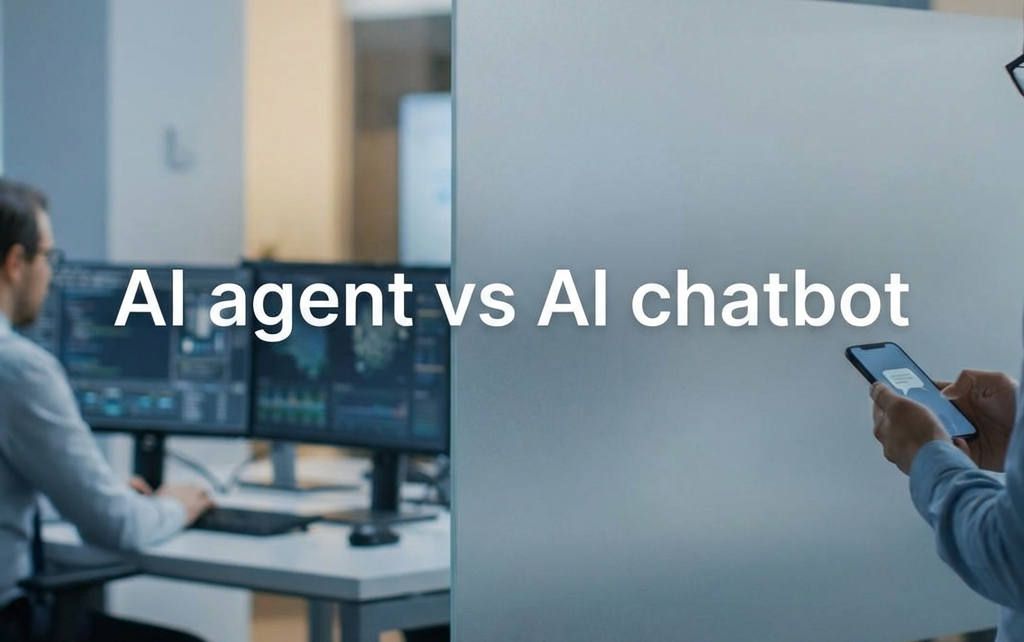


A few years ago, the AI news was mostly about generative AI — chatbots, image generators, writing assistants. Now a new term is showing up everywhere: agentic AI. And you're probably wondering: agentic AI vs generative AI: what's the difference, really?
The two terms are genuinely different — but they're also closely related, which is why the confusion is so easy to fall into.
In this article, I'll help you explore the differences between agentic AI and generative AI. I'll lead you through what each one actually means, where each approach tends to work well, and why more autonomy isn't automatically better.
In this article
Agentic AI vs Generative AI
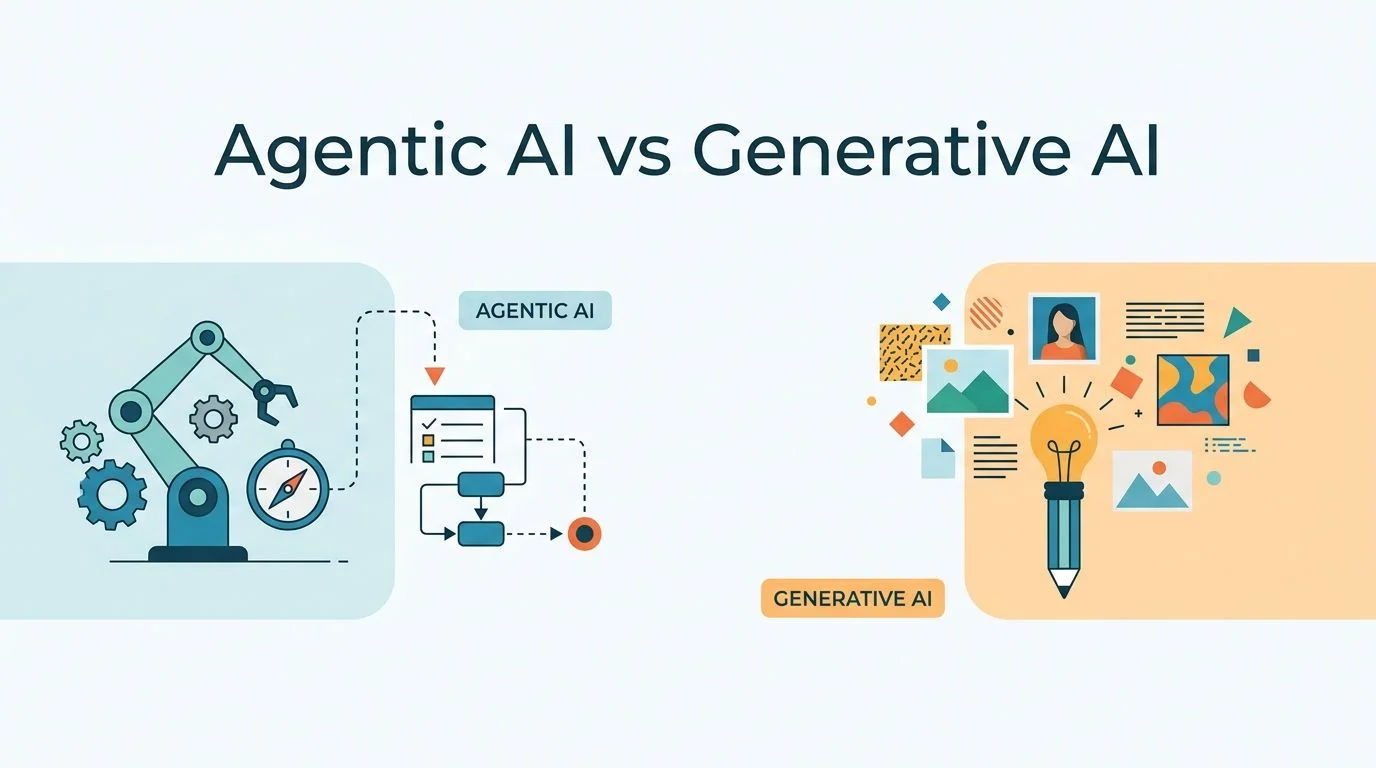
To put this plainly: Generative AI answers. Agentic AI follows through.
What Generative AI Actually Does
Generative AI refers to systems that create new content in response to a prompt. You give the system an instruction — write a summary, draft an email, generate an image, suggest some code — and it produces something new based on that input.
The key word here is reactive. Generative AI responds to what you ask. You are in the loop, driving each step. The model itself doesn't set goals or decide what to do next; it waits for your next prompt and then responds again.
The important thing to understand about generative AI is that it doesn't hold goals across time. It responds to the task you've put in front of it right now. Its "awareness" of your broader objective is limited to whatever you've included in your prompt.
What Agentic AI Does Differently
Agentic AI takes a different approach.
Think of agentic AI as giving the system a goal, rather than just a simple prompt. Instead of waiting for your next command, it rolls up its sleeves and figures out how to get the job done.
An agentic AI system (or an AI agent) plans its own steps, makes decisions, and uses tools—like checking databases or sending emails—without needing you to hold its hand at every turn. It loops, adjusts, and keeps working until it hits the target.
But this kind of autonomy doesn't mean it's running wild. It still operates strictly within the guardrails and permissions we set for it. Things usually only go sideways when the boundaries we built are incomplete or poorly tested.
A Quick Comparison Table of Agentic AI vs Generative AI
| Aspect | Agentic AI | Generative AI |
|---|---|---|
| Primary job | Execute workflows | Create content |
| Input style | Goal or objective | Prompt |
| Output | Completed steps, actions, outcomes | Text, images, code, summaries |
| Human involvement | Reduced — human governs, not directs | Frequent — human drives each step |
| Best suited for | Structured, multi-step operational tasks | Drafting, summarizing, ideating |
| Main risk | Wrong or harmful action | Wrong or misleading content |
When Generative AI Is Usually the Right Choice
For a large share of professional use cases today, generative AI is not only sufficient — it's the more sensible choice. Consider tasks like:
- Drafting emails, reports, or marketing copy
- Summarizing meeting notes or long documents
- Brainstorming and exploring options
- Rewriting content for different audiences or formats
- Producing first drafts of code or templates
When Agentic AI May Be Worth Considering
Agentic AI starts to make more sense when a task meets certain conditions: it's repetitive and well-defined, it spans multiple systems or steps, the rules governing decisions are clear, and the cost of delay is real.
The criteria for you to consider when deciding to use an agentic AI or not:
- Is the task structured? Agentic AI handles well-defined processes better than ambiguous ones.
- Are the tools and permissions clear? The system needs explicit access to what it needs.
- Are success criteria measurable? You need to know when the job is done correctly.
- Can failures be caught and contained? Errors in an agentic workflow can cascade. Guardrails matter.
- Is the cost of waiting higher than the cost of the risk? Agentic automation adds value when delay is genuinely expensive.
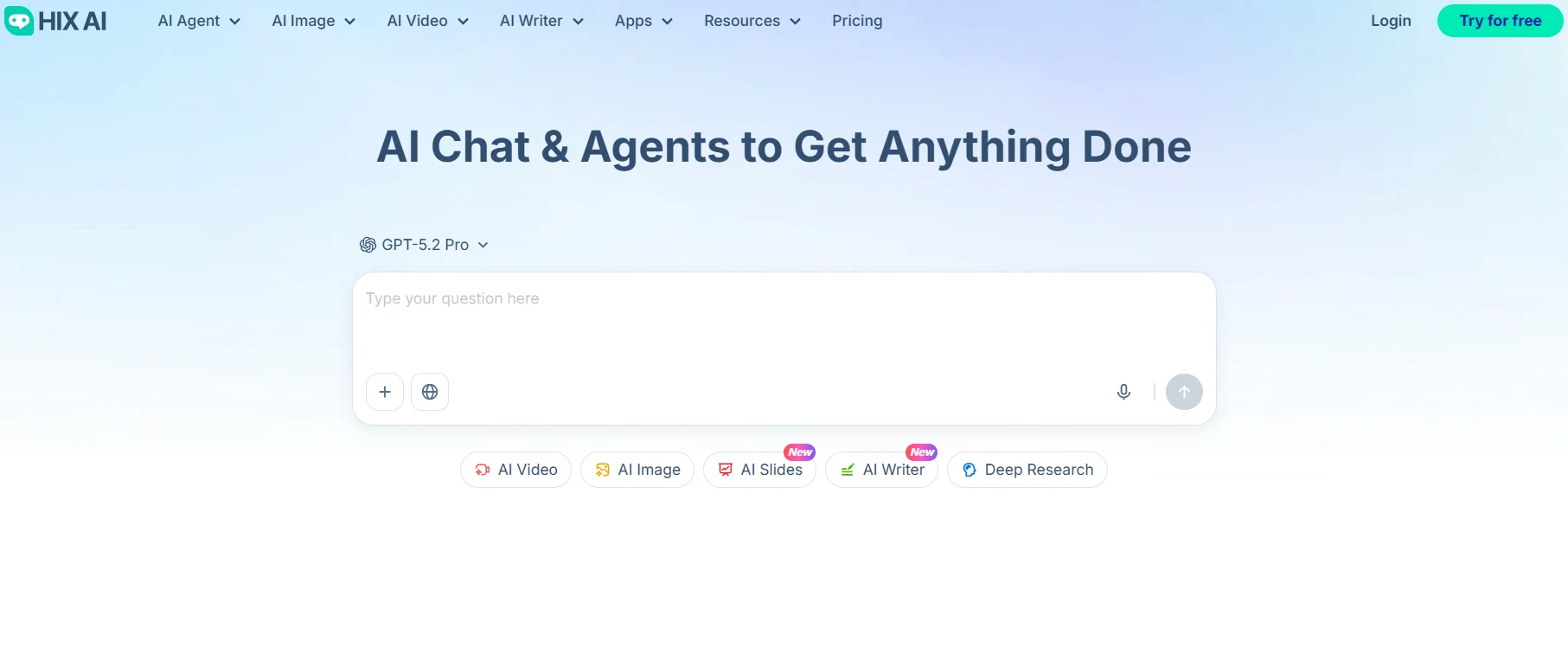
If you're looking for an agentic AI that supercharges your productivity? HIX AI is worth a serious look!
HIX AI serves as your all-in-one AI agent workspace. It brings together specialized agents that collaborate seamlessly to tackle complex tasks, from mapping out workflows to delivering polished, high-quality results.
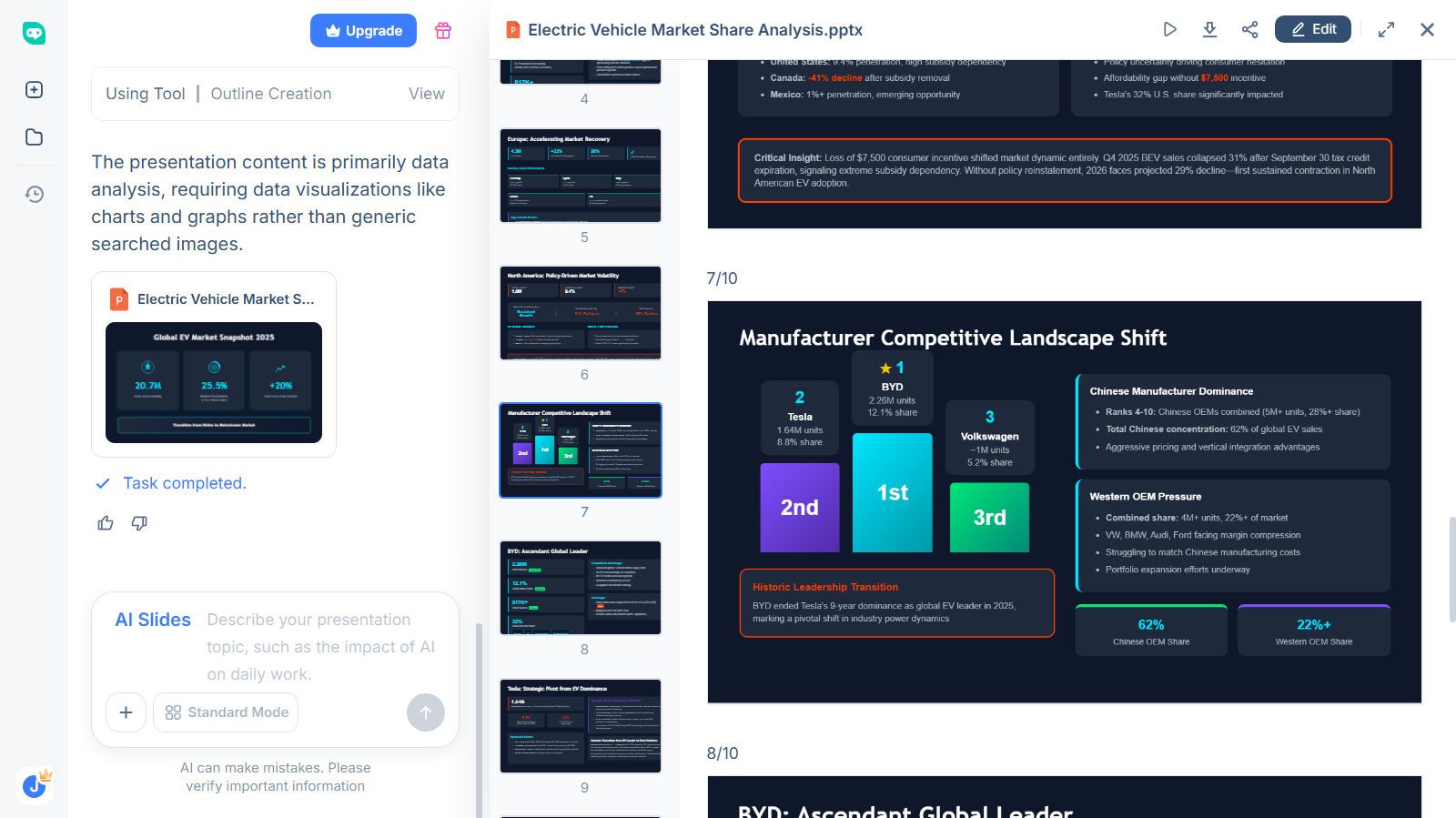
The possibilities with HIX AI are virtually endless. Whether you need to dive deep into complex research, craft compelling AI slides or reports, produce viral marketing content, or build data-driven websites, HIX AI has you covered. Simply share your goal, and it handles everything from start to finish — with precision and ease.
⚡ Easy to Use • 💳 No Credit Card Required • 🌟 4.9/5 Rating
Limitations on Both AIs
Generative AI is not without its frustrations. It can produce content that sounds authoritative but is factually wrong. Its outputs are only as good as the prompt that shaped them, which means unclear instructions tend to produce unclear results.
It has no inherent understanding of your organization's context, priorities, or constraints beyond what you've explicitly told it. And it can be confidently wrong in ways that aren't immediately obvious — which makes human review necessary.
Agentic AI carries a different and often higher-stakes set of limitations. It's significantly more complex to implement well: tool integrations, permission scoping, fallback logic, logging, monitoring, and exception handling are all part of the design work.
The maturity of the agentic AI ecosystem is still uneven, and many production deployments remain works in progress. Governance, accountability, and audit trails become genuinely critical concerns.
Neither category is plug-and-play. Both require thoughtful implementation and ongoing oversight.
Clearing Up a Few Common Misconceptions
Here are a few misconceptions about agentic AI vs generative AI, and the truths about them.
"Agentic AI is just a smarter chatbot."
"Al isn't here to replace SEOs; it's here to replace SEOs who don't use Al."
"If it uses a language model, it's agentic."
The model is only one part of the picture. What makes a system agentic is the surrounding architecture — tool access, execution loops, memory, orchestration. Swapping in a better model doesn't change the fundamental design.
"Agentic AI will replace generative AI."
The opposite is closer to the truth: agentic systems typically include generative components. One is a building block of the other.
"More autonomy means more value."
Value depends on reliability, fit, and risk management. An autonomous system doing the wrong thing at scale creates more harm, not more help.
The Takeaway
Generative AI creates. Agentic AI coordinates and acts. These aren't competing technologies vying for the same job — they're different tools suited to different kinds of problems, and understanding that distinction is genuinely useful.
And if you're looking for an AI agent to elevate your work or study, give HIX AI a try! It's your ultimate AI agent workspace to boost your productivity.
⚡ Easy to Use • 💳 No Credit Card Required • 🌟 4.9/5 Rating